The proposition
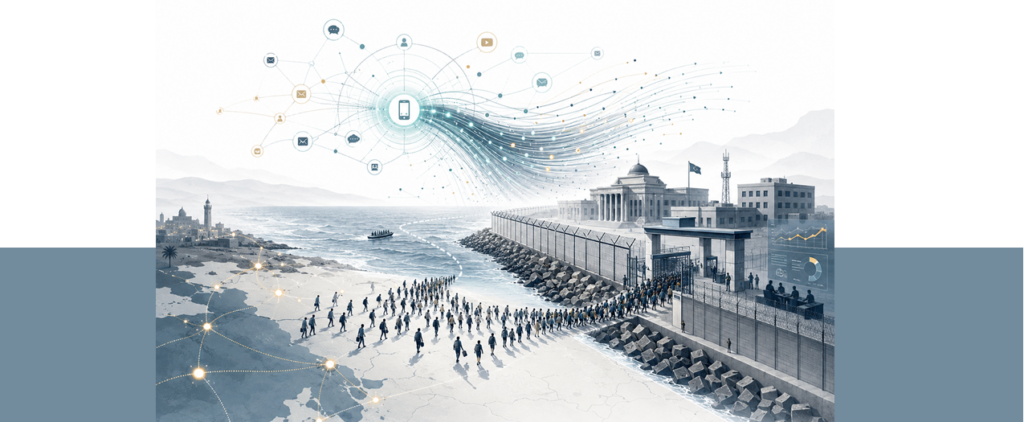
A physical barrier designed to manage gradual movement can be overwhelmed by a communication network capable of coordinating tens of thousands of people almost instantaneously.
The lesson is not to communicate less, suppress lawful movement, or weaken democratic protections. It is to recognize that the integrity of communication must become part of public infrastructure.
Law, narrative, technology, human agency, institutional capacity, and physical consequence can no longer be governed as separate systems.
Prepared by Kristin Raffaelle | Founder, Demosophy
Executive Summary
The events in Ceuta expose a modern systems vulnerability that reaches far beyond migration policy. A judicial ruling, administrative signal, political statement, news report, or visible example of successful entry can be simplified, distorted, algorithmically amplified, and converted into coordinated physical behavior before public institutions understand the emerging event.
As of July 31, 2026, credible reporting describes an extraordinary influx into Spain’s North African enclave of Ceuta following a July 8 Supreme Court decision limiting immediate “hot returns” for people intercepted at sea. Estimates have varied sharply as the event develops. The strategic fact is that receiving systems came under acute pressure as legal interpretation, online messaging, expectation, and movement converged.
The United States has experienced a related vulnerability at its southern border. U.S. Customs and Border Protection has warned that smugglers circulate false social-media claims about asylum and immigration rules to lure vulnerable people into dangerous crossings. The events are not identical, but they reveal a common mechanism: actors can exploit ambiguity faster than governments can establish a shared operating picture.
Four findings
1 The border is an information environment | The operational border begins before a person reaches geography. It extends through phones, platforms, courtrooms, newsrooms, smuggling networks, diplomatic relationships, and human expectations. |
2 Velocity changes governance | Networks operate in communication time; institutions often operate in legal, procedural, and political time. The gap between them is now a national resilience vulnerability. |
3 People carry the risk | Migrants are not the weapon. Their hope, fear, desperation, and movement can be weaponized by actors who remain distant from the physical danger and institutional consequences. |
4 Siloed competence can produce systemic failure | A court, agency, platform, newsroom, or humanitarian organization may fulfill its narrow mandate while the combined system still produces disorder, exploitation, suffering, and loss of trust. |
Core recommendation
Treat communication integrity as border infrastructure, democratic infrastructure, and national resilience infrastructure.
Ceuta: A Communication-to-Consequence Event
Ceuta is one of the European Union’s two land borders on the African continent. Its geography, legal status, economic asymmetries, and relationship with Morocco have long made it a pressure point. In 2026, irregular entries into Ceuta had already risen substantially before the late-July emergency. On July 8, Spain’s Supreme Court confirmed that the special summary-rejection provision for people crossing border barriers does not apply in the same way to migrants intercepted at sea while attempting to swim into Ceuta or Melilla; ordinary return procedures must instead be used.
A legal distinction that is precise within a judicial context can become radically different once it enters a high-velocity communication field. “A different procedure applies” can be reframed as “you cannot be returned.” “Legal protections exist” can become “entry is guaranteed.” When repeated through social media, private messaging, word of mouth, and smuggling networks, ambiguity can become perceived certainty and perceived certainty can become movement.
The communication-to-consequence chain
Institutional signal | Simplification or distortion | Algorithmic and social amplification |
Perceived urgency and opportunity | Human assembly | Physical movement |
Infrastructure strain | Political reaction | Loss of trust |
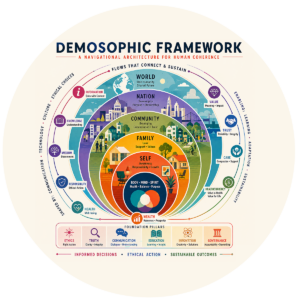
The Demosophic Purview
No single institution holds responsibility for the integrity of the whole communication field. The court governs doctrine. Border authorities govern entry and enforcement. Media organizations govern reporting. Platforms govern distribution systems. Humanitarian organizations govern care. Local communities absorb consequences. Migrants make decisions under unequal conditions of knowledge and power. Smugglers exploit the gaps.
When these actors do not share an anticipatory model of how information becomes behavior, the system can be legally active, technologically advanced, and operationally unprepared at the same time.
A necessary caution
The scale, causes, and orchestration of the late-July event remain under investigation. A systems analysis should not outrun the evidence. It should, however, identify the vulnerability revealed by the event: rapid narrative formation can generate physical consequences before institutions establish verified facts or coordinated responsibility. |
The U.S. Relevance
Americans should not treat Ceuta as a distant European anomaly. The U.S. southern border has also been shaped by the interaction of policy signals, administrative changes, court decisions, political rhetoric, news coverage, social media, diaspora networks, and organized smuggling. These forces can create expectations about who will be admitted, released, removed, or permitted to seek protection—and when.
In August 2025, the U.S. Border Patrol’s El Paso Sector warned that smuggling organizations were deliberately spreading false information on social media about asylum and immigration regulations. CBP stated that the purpose was to create false hope and lure vulnerable people into illegal and dangerous smuggling operations. That warning captures the central Demosophic concern: information is not merely descriptive. Under certain conditions, it becomes operational.
A border may be breached operationally before it is breached physically
- Criminal networks understand and market perceived policy consequences faster than official communications reach vulnerable populations.
- Visible examples of entry or release are treated as proof of a general rule, even when the legal and factual circumstances differ.
- Political and media narratives create urgency, inevitability, fear, or opportunity that can influence movement far beyond the original audience.
- Local communities and processing systems receive the physical consequences of decisions made across disconnected legal, technological, economic, and political domains.
The false binary
U.S. border debate is often reduced to enforcement versus compassion, sovereignty versus asylum, or security versus dignity. That binary obscures the systems problem. A nation can defend lawful borders and human dignity simultaneously only when it understands the full chain through which policy, information, incentives, and movement interact.
People are not the weapon. Their vulnerability can be weaponized. |
This distinction redirects attention toward the actors who design, distort, amplify, profit from, or politically exploit movement—without erasing the agency of migrants or the legitimate rights of receiving communities.
Applied Demosophic Framework for Response
Demosophy asks leaders to see the whole assembly: the people, institutions, technologies, incentives, relationships, and consequences operating across time. The objective is not total control. It is sufficient shared awareness to preserve lawful order, human dignity, democratic legitimacy, and the capacity to respond.
1. Require communication-impact assessment
Before consequential laws, rulings, or administrative changes take effect, model how they may be simplified, misinterpreted, marketed, or weaponized. Identify likely audiences, behavioral incentives, and infrastructure consequences.
2. Establish real-time narrative intelligence
Create multilingual, rights-respecting capabilities to detect rapidly accelerating claims about borders, asylum, emergencies, and public policy. Focus on velocity, reach, coordination, and foreseeable physical consequences—not merely whether a statement is technically false.
3. Build trusted counter-signaling
Publish clear explanations through the same languages, devices, platforms, communities, and trusted intermediaries used by smugglers and influence actors. Official accuracy without reach is operationally insufficient.
4. Create a common operating picture
Connect legal, diplomatic, intelligence, border, emergency-management, humanitarian, state, local, media, and platform perspectives. Shared awareness must precede coordinated action.
5. Assign platform responsibility proportionately
Technology companies should evaluate when recommendation systems, virality mechanisms, paid promotion, and private-group forwarding are foreseeably contributing to dangerous physical mobilization. Responsibility should be transparent, evidence-based, and compatible with lawful expression.
6. Protect people without manufacturing incentives
Rescue, due process, and humane treatment are obligations. At the same time, public systems must avoid allowing dangerous methods of entry or organized surges to become perceived advantages over lawful pathways.
7. Investigate the full chain of benefit
Determine who originated, financed, amplified, coordinated, or profited from misleading messages and movement. Examine criminal, commercial, political, and state incentives without presuming a conclusion before evidence is established.
8. Measure Return on Actual Value
Assess whether interventions improve safety, lawful order, trusted information, institutional capacity, human dignity, and community stability. Activity alone is not success; the system must produce actual value for the whole.
Leadership Imperative
The strategic question is no longer simply whether a nation can secure a physical border. It is whether democratic institutions can comprehend and respond to the informational forces acting upon that border before those forces become mass physical consequences.
A wall, fence, checkpoint, or legal process operates in physical and institutional time. A network operates in communication time. |
Until public institutions can operate across both, borders and communities will remain vulnerable to the conversion of information into expectation, expectation into coordinated movement, and coordinated movement into institutional destabilization.
The Demosophic invitation
Demosophy proposes a cross-sector leadership dialogue on communication integrity and the modern border, bringing together policy, law, national security, media, technology, humanitarian operations, and systems design. The central question is:
Who is responsible for the integrity of the full chain between an institutional signal, its digital amplification, the expectations it creates, and the physical behavior that follows?
The answer cannot belong to one institution. But responsibility cannot remain nowhere.
Three operating principles
- Awareness must scale with capability.
- Communication integrity must scale with communication velocity.
- Institutional comprehension must operate at the speed of the systems shaping human behavior.
About Demosophy
Demosophy—the wisdom of the people—is a See, Feel, Think Tank™ that convenes knowledge holders to convert dialogue into initiatives, showcases, and practical tools. It examines how human intelligence, technological capability, institutional design, and care can be assembled to improve decisions and reduce suffering.
Selected sources
- EFE, July 8, 2026: Spanish Supreme Court doctrine on sea interceptions and ordinary return procedures.
- Spain Department of National Security / Interior Ministry, June 30, 2026: migration data for Ceuta and Melilla.
- Associated Press, Financial Times, and The Guardian, July 30–31, 2026: developing reports on the Ceuta emergency.
- U.S. Customs and Border Protection, El Paso Sector, August 28, 2025: warning on smuggler misinformation.