The world is becoming more intelligent, more connected, and more consequential.
The question is no longer simply what our technologies can do.
The question is how we choose to participate.
A new book by Kristin Raffaelle about intelligence, systems, ethics, human agency, and the decisions shaping what comes next.
Not in a way that announces itself.
Not with one event you can point to and say that’s when it happened.
It is stealth. But it is everywhere.
And yet, all of it is happening at once. We are more connected than any time in history. But connection has not guaranteed coherence.
We have more information–and still struggle for clarity.
More capability–and still encounter outcomes that do not always match the lives we are trying to build.
Technology moves in months.
Institutions adjust in years
Human understanding can take generations.
89 Seconds is not a prediction of the future.
It is a framework for seeing the present more clearly.
Kristin Raffaelle examines the relationships among technology, health, economics, trust, identity, institutions, human behavior, and intelligent systems–and asks what happens when those forces begin interacting faster than the systems built to manage them.
The book invites us to recognize the signals around us, understand the systems we inhabit, and participate more consciously in the decisions that shape what comes next.
The future is not created someday. it is created one decision, one relationship, and one moment at a time."
The title began with a warning.
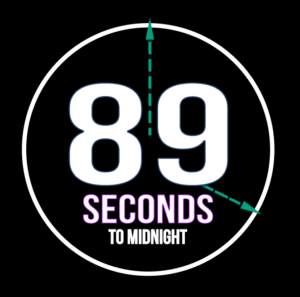
In 2025, the Bulletin of the Atomic Scientists moved the Doomsday Clock to 89 seconds before midnight.
In 2026, it moved again–to 85 seconds.
But this book is not about a clock.
It is about what we do with the time between recognition and consequence.
The number began as a warning.
The book turns it into an invitation.
We are living through the larger transition.
Human intelligence now interacts continuously with machine intelligence, biological systems, institutions, markets, communications networks, health systems, environmental conditions, and vast information environments.
The challenge is not simply adopting better technology.
It is learning how to live, decide, govern, build, care, and lead inside increasingly intelligent systems.
More intelligence does not always mean better decisions.
Human health, economic stability, environment, behavior, and care are increasingly intertwined.
Freedom means little if people cannot understand or realize meaningful choice inside intelligent systems.
What does this system require people trust — and has that trust been earned?
Systems work through relationships — not merely through their component parts.
SOME DECISIONS TRAVEL FARTHER THAN OTHERS.
89 Seconds is written for people whose decisions affect more than themselves.
People responsible for companies, technologies, institutions, communities, families, public systems, capital, culture, and future generations.
Not because leaders are expected to know everything.
Because they are often required to act before everything is known.
Modern leadership begins where certainty ends.
Executives
Builders
Policymakers
Health Leaders
Parents & Caregivers
Educators
Technologists
Community Leaders
Citizens
What if friction is sometimes information before it is failure?
Every system eventually lands on a human being.
What does the system require people to trust — and has that trust been earned?
What future are we reinforcing with this decision?
Her career has crossed telecommunications, biotechnology, healthcare technology, interoperability, digital transformation, strategy, and systems architecture.
She was not standing outside these transitions describing them after the fact.
She helped build, translate, deploy, and navigate them.
Over time, the recurring question became larger:
What happens when our technological capabilities begin advancing faster than our ability to understand their human consequences?
89 Seconds emerges from that question.
Our site uses cookies. We use them to improve your user experience. By entering our site you consent to the policies shown <here>