The Future of Knowledge Work
Kristin Raffaelle is the founder of Strategicbongo Strategic Advisory, Demosophy and AIHealthSPACE and the author of 89 Seconds. Her work focuses on Authentic Intelligence, Workforce Ennoblement, systems thinking, and the responsible integration of human judgment and artificial intelligence.
The future of knowledge work is not simply a story about human beings using artificial intelligence to work faster.
It is not merely about automating tasks, compressing timelines, generating more content, or increasing productivity.
It is about the reorganization of human contribution around a more consequential question:
What should human beings be responsible for when information, analysis, simulation, production, and coordination can increasingly be performed by machines?
This is where Workforce Ennoblement becomes not merely relevant, but necessary.
For much of the modern era, knowledge work meant possessing information, developing specialized expertise, applying judgment, producing documents, coordinating people, and making decisions.
Artificial intelligence is now compressing many of those functions.
AI can retrieve, compare, summarize, calculate, draft, translate, organize, model, monitor, and simulate at extraordinary speed. It can move across disciplines, identify patterns, preserve institutional memory, and generate plausible pathways through complexity.
This does not mean that knowledge work is disappearing.
It means that we are being forced to confront what knowledge work actually is.
The future is not primarily about producing more information. We already live inside an overabundance of information.
The future is about determining what matters.
It is about understanding what is true enough to act upon. It is about recognizing context and consequence, making wise distinctions, coordinating relationships, assuming responsibility, creating meaning, preserving dignity, and deciding what should happen next.
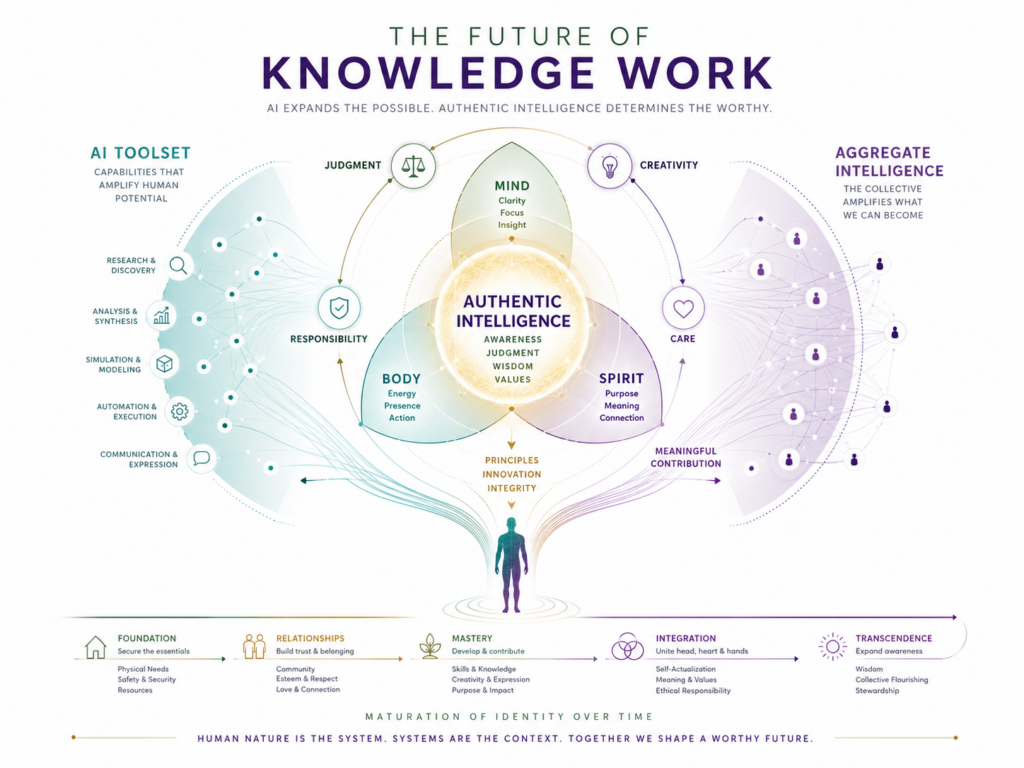
AI can dramatically expand the field of possibility.
Authentic Intelligence determines how we inhabit it.
Authentic Intelligence
Human Authentic Intelligence is not simply intellect.
It is the integrated human capacity to perceive, feel, remember, imagine, discern, care, relate, create, choose, and accept responsibility for consequences.
It includes knowledge, but it also includes embodied experience.
It includes reason, but also conscience.
It includes creativity, but also restraint.
It includes agency, but also an awareness that every action enters a living system of relationships.
The most valuable knowledge worker of the future may therefore not be the person who knows the most facts or produces the most output.
It may be the person who can responsibly orient powerful tools toward meaningful outcomes.
The defining capability becomes directionally correct participation.
Can a person see what is happening clearly enough to act wisely?
Can they understand the relationships involved?
Can they identify what should be protected, what should be changed, and what should be allowed to emerge?
Can they use AI without surrendering judgment, responsibility, or agency?
These questions are becoming central to modern work.
The phrase knowledge worker may eventually become too narrow.
We are moving toward an economy of contribution work.
In contribution work, value is not measured solely by hours worked, tasks completed, credentials held, or artifacts produced.
It is measured by what a person enables within the larger system.
Did they improve the quality of a decision?
Did they reduce confusion?
Did they prevent harm?
Did they strengthen trust?
Did they help people coordinate more effectively?
Did they identify a neglected relationship or an unseen dependency?
Did they preserve important knowledge?
Did they make a process more accessible and fair?
Did they create the conditions through which others could perform well?
Did they help convert information into knowledge, knowledge into insight, insight into wisdom, and wisdom into action?
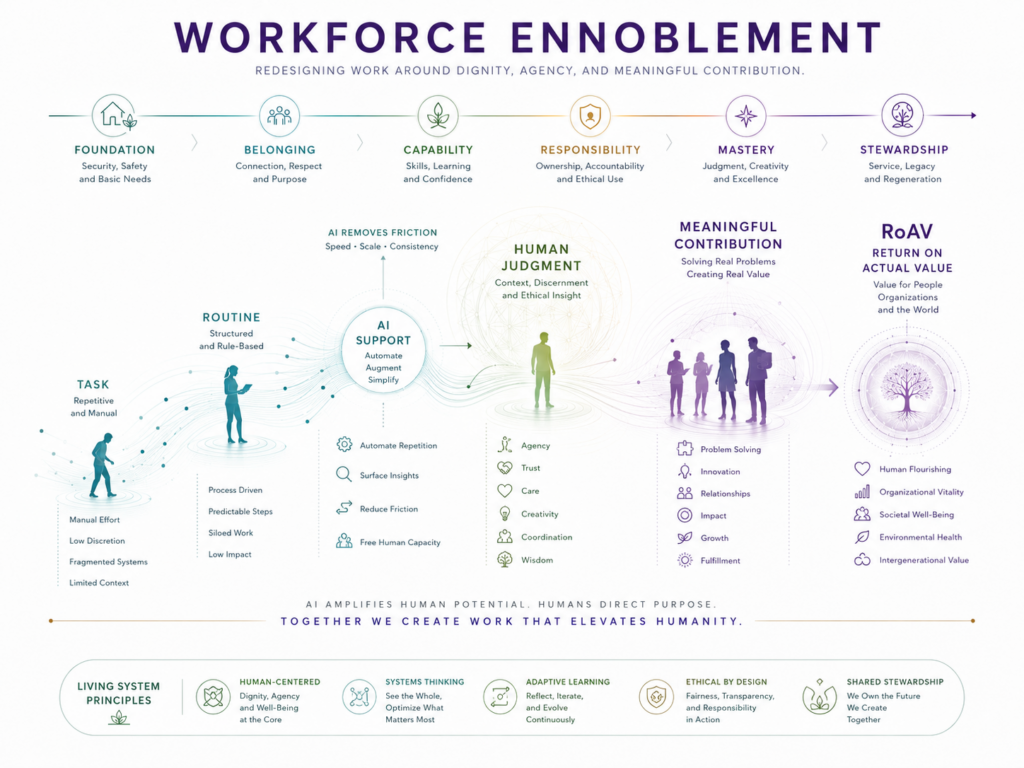
This is the basis of Return on Actual Value, or RoAV.
Traditional productivity measures often reward activity while remaining blind to consequence. They count output without adequately examining whether that output improved the system.
RoAV asks a deeper question:
What actual value entered the system because this person participated?
That value may be financial, operational, relational, creative, cultural, environmental, developmental, civic, or human.
Often, it will be several of these at once.
The future of work requires us to see an organization not merely as a collection of jobs, but as a living architecture of contribution.
Each role exists because a relationship must be maintained, a responsibility must be carried, a decision must be made, a condition must be understood, or a form of value must move.
Once those relationships become visible, work can be redesigned more intelligently.
Artificial intelligence changes the economics of cognition.
Activities that were once scarce, slow, or expensive are becoming abundant, rapid, and increasingly accessible.
This means that the market value of routine cognitive production may decline.
But the value of orientation rises.
The value of judgment rises.
The value of trust rises.
The value of disciplined imagination rises.
The value of lived experience rises.
The value of knowing when not to act rises.
The value of understanding a human being within context rises.
The value of holding a North Star while circumstances fluctuate rises.
AI will increasingly function as a full-spectrum modern toolset: a research environment, pattern-recognition system, simulation partner, communication assistant, memory layer, design instrument, decision-support system, coordination mechanism, and, at times, a coherence mirror.
But a tool capable of influencing a person’s future does not thereby possess that person’s agency.
That distinction is foundational.
AI can inform human agency.
It can augment human agency.
It can also obscure, manipulate, or diminish human agency.
It must not be permitted to quietly replace human responsibility merely because its output appears authoritative.
The future of knowledge work therefore depends on a new literacy: the capacity to work with algorithmic intelligence without surrendering Authentic Intelligence.

Workforce Ennoblement is not a more attractive name for employee engagement.
It is not corporate kindness layered onto an unchanged industrial model.
It is not an effort to make people feel better about work that remains extractive, incoherent, or unnecessary.
Workforce Ennoblement is the redesign of work around the recognition that human beings are not merely labor inputs.
They are participants in living systems.
They carry history, knowledge, relationships, sensory awareness, imagination, responsibility, vulnerability, and unrealized capacity.
To ennoble work is to make the contribution visible and worthy.
It means helping people understand why their role exists, who and what depends upon it, what information must flow through it, what authority belongs with it, what judgment is required, where AI can extend capacity, where human presence remains essential, and how the work contributes to the whole.
Ennoblement is not the inflation of every task into a heroic calling.
It is the restoration of integrity between the person, the work, and the outcome.
A role becomes ennobling when the person can see that their participation matters, exercise appropriate agency, develop greater capacity, and understand the consequences of what they do.
The transition into the Intelligence Age cannot be handled as another wave of mechanistic workforce transformation.
That language often conceals the experience of the people whose lives are being transformed by someone else’s strategy.
A gracious transition begins with truth.
Some tasks will disappear.
Some professions will be radically altered.
Some forms of expertise will lose their economic protection.
Some organizational layers will become unnecessary.
Some people will experience relief.
Others will experience disorientation, grief, loss of status, or fear.
Workforce Ennoblement does not deny disruption.
It refuses to treat human beings as disposable residue from technological progress.
A graceful transition requires distinguishing among different forms of work.
There is work that machines should perform because it is repetitive, hazardous, depleting, or unnecessarily bureaucratic.
There is work that machines can support while a human retains judgment, accountability, and relational responsibility.
There is work that humans should continue to perform because embodiment, trust, care, consent, moral responsibility, and lived understanding are central to the outcome.
And there is work that has not yet fully existed because human capacity has been consumed by administration, scarcity, and avoidable friction.
That final category may represent one of the greatest opportunities of the Intelligence Age.
Released from unnecessary cognitive labor, people may be able to turn toward forms of contribution that have long been undervalued or neglected: caregiving, mentoring, restoration, stewardship, community building, conflict navigation, education, health, creativity, contemplation, environmental repair, institutional renewal, and the design of more humane systems.
This is not the end of work.
It is the possibility of better work.
The human premium will not arise from competing with machines at machine-like tasks.
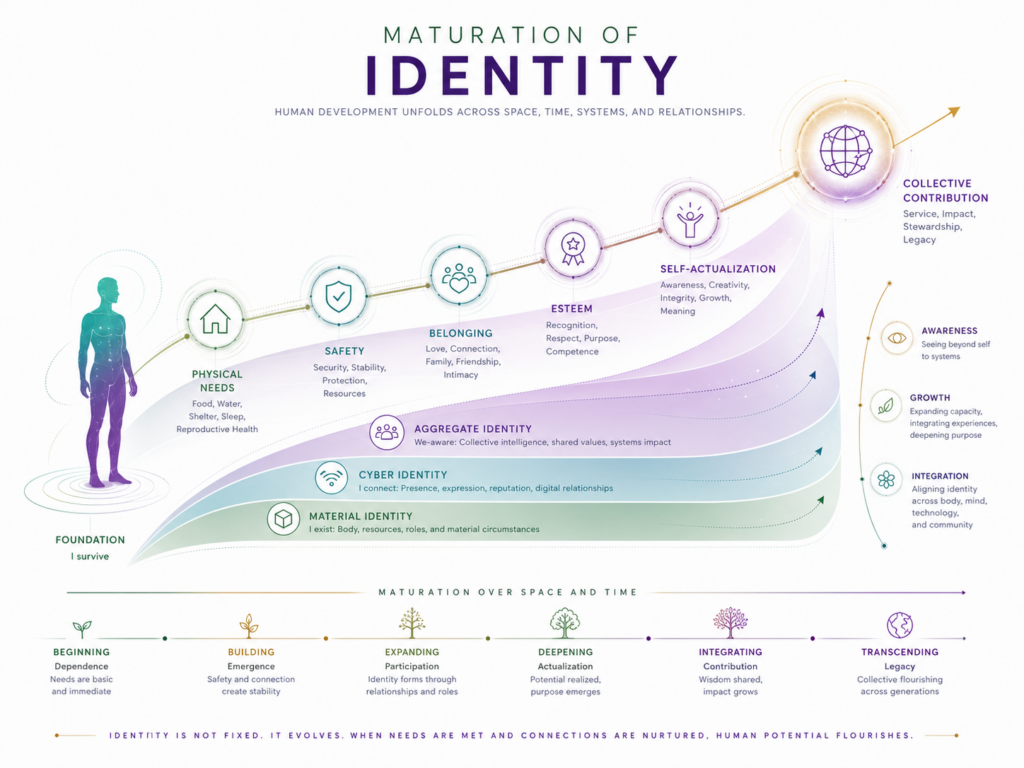
It will arise from becoming more fully capable human beings.
The future will increasingly reward people who can perceive the whole while acting within a part.
It will value those who can move between disciplines and perspectives, identify consequential relationships, ask better questions, remain steady in ambiguity, communicate across differences, recognize second- and third-order effects, create trust without demanding conformity, and bring care, wisdom, and responsibility into systems of scale.
This is mature human participation.
It is also why education, leadership development, and professional formation must change.
We should not train people merely to execute known procedures.
We must help them develop judgment, self-awareness, systems awareness, communication, cooperation, collaboration, creative innovation, and the ability to use AI without becoming subordinate to it.
The mature worker will need technical fluency and contemplative capacity.
Analytical rigor and relational intelligence.
Speed and patience.
Confidence and humility.
Agency and accountability.
Workforce Ennoblement asks leaders to see an organization differently.
Not simply as an organizational chart.
Not as a stack of functions.
Not as a portfolio of human resources.
But as a dynamic system of relationships, forces, information, commitments, dependencies, and value exchanges.
Every constituent—human, technological, financial, regulatory, cultural, and environmental—exerts incoming and outgoing forces.
Conditions shift.
People oscillate.
Markets change.
Technologies evolve.
Trust strengthens or decays.
The role of leadership is not to freeze this living system into perfect control.
It is to create enough clarity, coherence, and shared purpose that creative movement can occur without the whole becoming unstable.
That requires a North Star.
It requires shared organizing principles.
It requires feedback.
It requires boundaries.
It requires room for adaptation.
And it requires the recognition that efficiency is not the same as health.
A system can become extremely efficient at producing the wrong outcome.
The future organization must continuously ask:
Are we doing the right things, at the right times, for the right reasons—and are we learning from what actually happens?
A Workforce Ennoblement model begins with purpose, not job descriptions.
It identifies the organization’s North Star and then maps the relationships necessary to move toward it.
From there, it clarifies the value each relationship is meant to produce, the communication and information that must flow, the decisions that must be made, the human judgment those decisions require, the tools that can support them, the risks and consequences involved, and the feedback needed for refinement.
Jobs may become more fluid, but responsibilities can become clearer.
AI can be introduced not merely to reduce headcount, but to remove friction, reveal patterns, preserve knowledge, expand access, and improve the quality of human participation.
Performance can be evaluated not only through output, but through contribution to system health.
Leadership can become less about controlling activity and more about creating the conditions for coherent agency.
People can be given a clearer view of the whole, rather than being instructed to optimize only their fragment.
And organizations can recognize that care is not separate from performance.
Care is part of the infrastructure that makes sustained performance possible.
The Intelligence Age can become an age of profound human diminishment.
It can produce surveillance, dependency, cognitive passivity, extreme concentrations of power, and the quiet erosion of personal and collective agency.
Or it can become an age of human maturation.
AI can help us see more, understand more, connect more, anticipate more, and create more.
But greater capability does not automatically produce greater wisdom.
That remains our work.
Workforce Ennoblement offers a gracious architecture for this transition because it does not begin by asking how much labor can be removed.
It asks:
What becomes possible when human beings are relieved of unnecessary work and invited into more meaningful contribution?
It does not romanticize labor.
It honors participation.
It does not attempt to preserve every existing job.
It seeks to preserve human dignity, agency, development, and the opportunity to matter.
It does not place humanity above technology in a simplistic hierarchy.
It places human Authentic Intelligence and artificial intelligence into right relationship.
The future of knowledge work, then, is not knowledge alone.
It is awareness becoming decision.
It is decision becoming coordinated agency.
It is coordinated agency becoming actual value.
It is human beings and machines working together without confusing their roles.
Artificial intelligence expands the possible.
Authentic Intelligence determines the worthy.
Workforce Ennoblement creates the conditions through which people can participate in that worthy future graciously, gracefully, and beautifully.

Our site uses cookies. We use them to improve your user experience. By entering our site you consent to the policies shown <here>