The Demosophic Framework: Humanity’s Top-Down, Bottom-Up Assembly


Foundational Definition
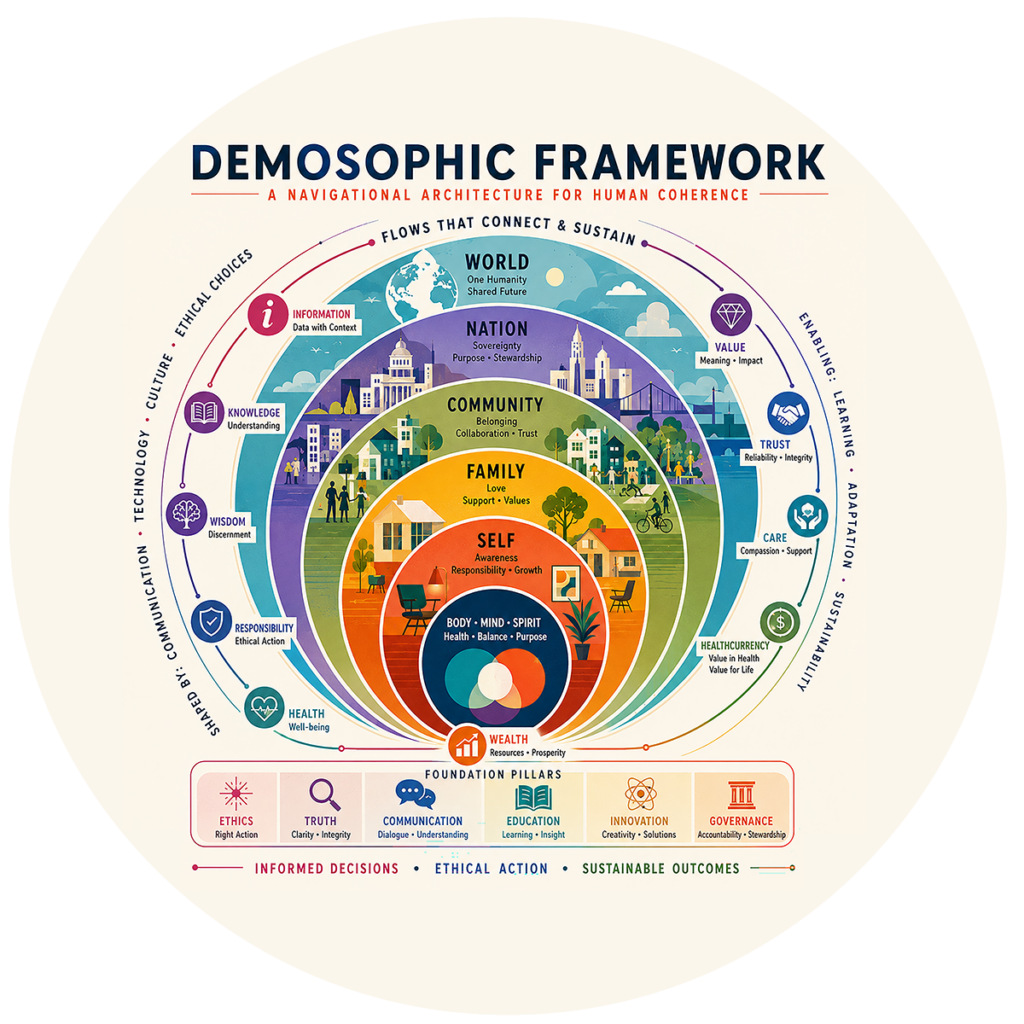
The Demosophic Framework™ is a multidimensional, systems-based assembly for understanding and navigating humanity’s interconnected existence. It provides complementary top-down, bottom-up, and cross-sectional perspectives that reveal the structures, forces, relationships, and flows of communication and information that continuously form and inform individuals, communities, institutions, nations, and civilization. Rooted in the recognition that people are not separate from the systems they inhabit or create, the Framework enables comparative understanding of how human experience, knowledge, values, technology, and governance interact across developmental cycles. Through sensing, measuring, discernment, generative learning, and consequential feedback, it supports the cultivation of structural integrity, coordinated agency, and creative innovation. Its purpose is to help humanity orient from its authentic present state toward a shared North Star—reducing unnecessary suffering and enabling people and their systems to become healthier, wealthier, wiser, and more capable of flourishing—with balance, agility, and control. This definition synthesizes the earlier Framework’s emphasis on forces, fronts, human fundamentals, and structural integrity with the more recent applied work on intelligence, feedback, and human agency.The assembly: Four dimensions of understanding
The original Framework presents four interacting domains, not four independent sectors.- Science & Technology – Understanding and extending our capabilities
- Philosophy & Governance -Organizing values, responsibilities, and collective action
- Sacred & Spiritual – Exploring meaning, purpose, and foundational principles
- Human Endeavor – Embodied experience, relationships, and the realities of daily life
The North Star: Shared direction without enforced sameness
“This is one of the Framework’s most valuable distinctions.”A shared North Star does not require everyone to believe the same things, pursue identical goals, or live according to one prescribed model. It establishes a common orientation grounded in human fundamentals while allowing diversity of perspective, experience, creativity, and choice. The North Star might be expressed as:
To cultivate the conditions through which people and their interconnected systems can reduce suffering, strengthen structural integrity, preserve creative freedom, and continually realize greater health, wealth, wisdom, and mutual value.This makes the North Star a navigational reference rather than a static destination. We do not know everything. Nor can we foresee every manifestation of progress. But we can become better at recognizing where we are, discerning what matters, learning from consequences, and correcting course.
The reciprocal forming and informing model
Simplified operational relationship within the multidimensional assembly.
Every interaction can become an opportunity for greater discernment and learning. Information is interpreted within context, translated into action, and tested through consequences that return to inform subsequent decisions.
This is not simply a human learning model. Its logic can be applied to the maturation of institutions, communities, intelligent infrastructure, and civilization itself.
Where the Science of Consciousness work advances the Framework
The accepted 2026 poster and whitepaper examines packetized intelligence and structural integrity across lifespans. It asks how information can retain provenance, context, and relational meaning as it moves between biological and digital systems, and how those processes relate to continuity, awareness, and agency. Here the personal digital twin becomes a particularly tangible application. Rather than treating a person as an isolated collection of health or behavioral data, the twin can function as a reflective coherence mirror, making patterns and relationships visible that a person might otherwise struggle to recognize. This could support a person in orienting within their actual circumstances, assessing alternatives, and navigating their day in a life with increasing balance, agility, and control. It also supplies a pathway for testing whether a more integrated intelligence environment genuinely increases human capability, rather than merely collecting more data or automating additional decisions. The consciousness proposition remains an area of scientific inquiry: the Framework offers an architecture for examining information, integration, and reciprocal formation, but does not establish that information exchange alone produces subjective experience.The Distilled Expression
Together, these establish a coherent progression from understanding existence, to navigating existence, to responsibly extending our capacity within it.
- The Demosophic Framework is used for seeing the whole, understanding our human relational place within it, and navigating wisely toward what we can become.
- The Demosophic Framework™ is humanity’s multidimensional, top-down and bottom-up assembly for understanding, orienting, and navigating our interconnected existence. It reveals how people and the systems they create continuously form and inform one another through communication, information, experience, and consequential action. By enabling us to see broadly and deeply—from the totality of systems to the realities of an individual’s day in a life—it supports comparative understanding, generative learning, structural integrity, and coordinated agency. Grounded in shared human fundamentals yet open to the diversity of human experience, the Framework offers a means of navigating continual change toward a shared North Star: a healthier, wealthier, wiser humanity, empowered to flourish through creative freedom, responsible participation, and ever-improving capacity for balance, agility, and control.

