

Space as Human Habitat
A Demosophic White Paper on Shared Environments Responsibility and Modern Life
We suggest that modern society consider space in ways that move—from space as “surface”, to space as habitat, to space as a field of rights, relationships, responsibilities, and consequences.
Space is the shared medium of human existence. As modern systems increasingly alter the space above, around, between, and within us, we must become conscious enough to understand those connections, govern their effects, and use technology to protect and extend the conditions that make life possible. Importantly, this unifies the physical, ecological, civic, digital, orbital, relational, and inner dimensions of space—and as a result, provides this paper its ethical purpose.
The Relational Question this paper asks: What protections do human beings require within the spaces where they live, sleep, think, recover, and maintain agency?
Executive Summary
Space is where life happens. It is the air above a home; the streets and rooms through which people move; the orbit around Earth; the digital channels through which information travels; and the physical, sensory, cognitive, and relational room people need to remain safe, healthy, secure, private, free, and themselves. Space is physical, ecological, technological, civic, personal, and relational at the same time.
Modern societies often treat space as real estate:
Modern societies routinely treat space as neutral—an available surface for growth, an area to occupy, route through, build upon, instrument, connect, digitize, and monetize. That framing is incomplete because space is not merely a surface. A space may be legally available or technically usable while being experienced as intrusive, unsafe, unhealthy, surveilled, or inaccessible. It may be privately owned, publicly governed, or institutionally operated while distributing benefits and burdens unevenly. It may appear empty while carrying air, sound, signals, aircraft, satellites, wildlife, attention, memory, and consequence.
This paper argues that space should be understood as habitat and commons. The central question is not only who has authority to use a space. It is also what that use changes for the people, systems, and living conditions connected to it. The quality of a decision depends on whether its makers can see those connections, gather relevant knowledge, include the affected, and correct course before “harm” compounds.
In this paper, harm means more than immediate physical injury. It includes cumulative exposure, compromised safety or health, loss of privacy or agency, disruption of sleep and recovery, surveillance or intrusion, displacement of risk onto less powerful people or living systems, ecological degradation, and the loss of future choices. Not every inconvenience is harm; responsible assessment must examine severity, duration, distribution, reversibility, and the ability of affected people to respond.
The argument moves across scales. Outer space is governed by principles that describe it as a domain for the benefit and interests of all countries and not subject to national appropriation [1]. Earth science describes the atmosphere, hydrosphere, geosphere, and biosphere as interacting parts of one Earth system [5]. The Federal Aviation Administration describes the National Airspace System as a network of controlled and uncontrolled airspace that supports shared movement across the country and beyond [3]. Public health guidance shows that environmental “noise” can affect sleep, cognition, cardiovascular health, and well-being [4]. These sources point in one direction: space is not an unused backdrop. It is a medium of shared life and shared responsibility.
Public health guidance on environmental noise provides one well-established example of how external systems can enter and alter human life. But noise is only one spatial impact. A fuller assessment must also consider air, light, vibration, surveillance, data capture, visual intrusion, physical risk, restricted movement, loss of privacy, attention, sleep, recovery, and the ability to feel secure within one’s own surroundings. These sources point in one direction: space is not an unused backdrop. It is a medium of shared life and shared responsibility.
But is noise all that we care to assess? Where does privacy destabilize security? At the same time how do we stay safer in the modern context without breaching rights to privacy? Case in point it is unlawful to fly drones over animals in Yellowstone Park, why? What about human space?
Privacy is not the absence of security. Privacy is one of the conditions that make security, autonomy, dignity, and human judgment possible. Security measures that enter personal space should therefore be necessary, proportionate, transparent, purpose-limited, time-bounded, and accountable.
The practical proposal is a SPACE Stewardship Protocol. Decision-makers should see the conditions that already exist, place each choice in its wider context, assess effects across people and systems, coordinate authority with accountability, and evolve through feedback. This is a cycle of success for complex decisions: notice, learn, practice, measure, correct, and repeat.
The Core Claim
Every space that supports life should be evaluated as a field of relationships. Use is not the same as ownership. Leverage and growth are not automatically improvement. A decision that creates value for one actor can impose uncounted costs on others. Modern leadership requires the capacity to understand how the dots connect before a change becomes irreversible.
What This Paper Asks
- Treat airspace, orbital space, built space, digital space, and relational space as connected parts of human habitat.
- Measure lived effects as well as technical performance, including noise, sleep, privacy, attention, access, safety, and ecological continuity.
- Make authority answerable to the people and systems affected by its decisions.
- Use modern tools as instruments for understanding and capacity, not as substitutes for reality.
- Build continuous learning into public and private decisions so that correction is normal before harm compounds.
Contents
- Executive Summary
- Space Is Where Life Happens
- One Word Many Fields
- Space as a Shared Commons
- The Modern Human Habitat
- When One Decision Alters Many Lives
- Learning as Stewardship
- The Space Stewardship Protocol
- Recommendations for Decision Makers
- Applications Across Modern Infrastructure
- Conclusion
- Appendix A: Working Definitions
- Appendix B: Decision Review Matrix
- Appendix C: Questions for Ongoing Practice
- Selected References
Our governing logic
- Space becomes the full field of human conditions.
- Harm becomes cumulative, distributed, and sometimes invisible.
- Privacy becomes a spatial and civic condition, not merely a data issue.
- Security must be balanced with rights and agency.
- Personal space becomes a distinct layer of human development.
- Noise becomes one example within a larger field of impact.
- Stewardship becomes responsibility for the conditions one’s decisions alter.
1 Space Is Where Life Happens
People often speak of space as if it were the absence of things. In lived experience, space is the condition that lets things happen. Air moves through it. Light reaches us through it. Aircraft, birds, weather, radio signals, satellites, vehicles, and people move through it. The distance between bodies can create safety, privacy, intimacy, or isolation. A room can support rest or produce stress. A neighborhood and home can create belonging or become a corridor for someone else’s priorities.
Space is therefore not one thing. It is a set of environments that overlap. A person standing in a home occupies a physical location, breathes within an atmosphere, hears an acoustic environment, receives electromagnetic and digital signals, participates in an economic and civic system, and carries an inner field shaped by memory and attention. The same person may be affected by decisions made at a municipal airport, a utility control room, a telecommunications company, a satellite operator, or a national regulator.
The first task of responsible modernity is to notice this condition. We live inside what human beings have made. Man-made systems now fill the visible, audible, aerial, digital, and social environment. Because those systems are connected, their effects do not remain inside the boundary where a decision was made.
This does not make every change wrong. It makes every change consequential. A mature society can pursue movement, safety, research, communication, commerce, growth and advancement while still asking who receives the benefit, who bears the burden, what the baseline was, and what evidence will show whether the choice worked.
A Practical Definition
For this paper, space means the physical and relational field in which life, movement, information, and consequence occur. It includes what can be measured directly and what must be understood through lived experience. The definition is deliberately broad because narrow categories often silo and impede connections that matter to human safety, security, “health and care” in their near-existential sense and public legitimacy.
2 One Word Many Fields
A useful understanding of space begins by separating its layers without pretending they are independent. The following table is a working map rather than a final taxonomy.
| Layer | What it includes | What responsible use must consider |
|---|---|---|
| Personal / interior space | The body, home, sensory field, attention, thought, privacy, identity, memory, and capacity for recovery. | |
| Physical space | Land, buildings, rooms, streets, borders, and distance between bodies. | Access, safety, mobility, shelter, privacy, and the distribution of benefits and burdens. |
| Atmospheric space | Air, weather, sound, temperature, light, and the protective envelope around Earth. | Health, climate, noise, air quality, sleep, and the conditions that make life possible. |
| Airspace | Controlled and uncontrolled areas used by aircraft, drones, emergency services, and other operations. | Safety, route design, frequency, noise, risk, transparency, and the people living below. |
| Outer space | The orbital and celestial environment beyond Earth’s atmosphere, including satellites and debris. | Peaceful use, shared benefit, long-term sustainability, liability, and the cumulative effects of activity. |
| Built and infrastructural space | Water, power, energy, transportation, telecommunications, and internet-enabled relationships. | Reliability, resilience, access, maintenance, affordability, and failure consequences. |
| Relational space | The distance, attention, trust, privacy, and social conditions people hold between one another. | Consent, dignity, boundaries, belonging, and the ability to think and recover without coercion. |
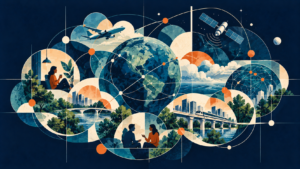
The value of this map is practical. A new flight path is an airspace decision, but it is also an acoustic, health, privacy, neighborhood, and governance decision. A satellite network is an outer-space project, but it also affects communications, observation types, security, night skies, and the distribution of information. A new data center is an infrastructure decision, but it is also a water, energy, land, heat, and community entanglement.
3 Space as a Shared Commons
Space as a “commons” is not simply a resource that nobody owns. It is a field of constructive and destructive interferences. Furthermore, many people, places and things (animals and beyond) depend on it and therefore those governing must place attention to shared conditions near and longer term. The atmosphere, public airspace, orbital lanes, quiet, public rights of way, and the information channels that connect people all have features of a commons. Their use by one actor can change what remains available to others.
Outer-space law provides a clear starting point. The 1967 Outer Space Treaty states that exploration and use of outer space should be carried out for the benefit and in the interests of all countries and that outer space and celestial bodies are not subject to national appropriation [1]. This principle does not answer every modern question, but it establishes a durable orientation: access and activity carry obligations to the wider human community.
The same logic applies closer to Earth. The National Airspace System is an operational network that makes movement possible across controlled and uncontrolled airspace [3]. Its public value is real, but public value is not the same as unlimited discretion. When a route, frequency, altitude, or engine-testing practice changes, people below may experience a new pattern of sound, vibration, visual intrusion, traffic, or anxiety. Those effects belong inside the decision record.
The language of nuisance can be too small for the reality. A nuisance suggests an irritation added to an otherwise stable life. Repeated overflight, noise, vibration, loss of quiet, or the anticipation of disruption can alter the conditions in which people sleep, work, recover, and feel at home. Public decisions should be able to recognize these effects without requiring a person to prove that their entire life has been damaged before their experience counts.
Stewardship Is Different from Possession
A steward may operate a system without owning every value that system affects. An airport can manage operations without owning the private interior life of every household under a flight path. A satellite operator can launch a useful service without owning the orbital environment. A platform can host communication without owning the attention, relationships, or consequences that move through it.
The relevant question is therefore not only who has the legal power to act. It is whether the actor has done the work required to understand the field it is changing and whether the affected have a meaningful way to shape, challenge, or correct the decision.
4 The Modern Human Habitat
The modern human habitat is assembled from natural and man-made conditions. Earth-system science describes interactions among atmosphere, biosphere, hydrosphere, and geosphere [5]. NASA describes Earth observations as a way to understand how land, rivers, forests, oceans, crops, and other living systems change together over time [6]. The scientific lesson is simple: systems that appear separate are often connected by flows of energy, matter, information, and life.
Human life follows the same pattern. A home is not only a parcel. It is a place where a person sleeps, thinks, raises children, receives information, tends to health, and recovers from the demands of the outside world. A neighborhood is not only a collection of properties. It is a local field of movement, memory, social trust, ecology, and expectation. A region is not only a market. It is an interdependent system of water, power, energy, transportation, telecommunications, housing, work, and care.
When an institution changes one layer, it may alter the whole field. This is why decisions that appear pure business or technical can become personal. The technical question may be whether a route is efficient or a system is safe. The human and hence civic question is whether the economic, perceived right, potential use, efficiency or safety has been achieved by shifting unmeasured costs into the bodies, homes, attention, health, or future options of other people.
Privacy as a Spatial Condition
Privacy is often discussed as control over personal information. It is also a spatial condition. People need some control over who can enter their physical, sensory, informational, and psychological field. A person may not own the sky, but they still experience the sky above their home as part of the place where they live. The same is true of sound, surveillance, light, and the persistent presence of systems that cannot be escaped inside a private dwelling.

This does not mean that every perceived impact is a proven “medical” injury. It means that the lived conditions of privacy, quiet, orientation, and recovery are relevant to human well-being and deserve to be measured honestly. WHO guidance identifies environmental noise as a public health concern associated with annoyance, sleep disturbance, hearing effects, cognitive impairment, and cardiovascular risks [4]. A decision process that counts only property lines may therefore miss the actual exposure.
5 When One Decision Alters Many Lives
People who make decisions affect one and many. The greater the reach of a decision, the greater the responsibility to keep learning. This responsibility applies to elected officials, regulators, executives, engineers, planners, researchers, and anyone whose authority can change the conditions under which other people live.
The airport and flight-path discussion in Scottsdale, Arizona, makes the issue concrete. An airport may seek more flights, larger aircraft, different procedures, or new testing activity. Those goals may have operational reasons. Residents may still experience the change as an intrusion into the lived field they have occupied for decades. Both statements can be true. The decision becomes legitimate only when the process can hold both the system objective and the human effect in view.

A mature review should ask at least five questions. What changes in the physical and sensory environment? Who experiences the change most often and most intensely? Which benefits are public, private, or concentrated? What evidence will distinguish a tolerable adjustment from a compounding harm? What can be reversed if the assumptions prove wrong?
The question is not whether a community must reject every new plane, satellite, road, data center, or transmission line. The question is whether innovation and growth can proceed without treating the people, living systems, and shared conditions beneath, around, between, and within those systems as expendable. A technical or economic benefit does not by itself justify transferring unmeasured costs—noise, expense burden, surveillance, risk, displacement, ecological damage, loss of privacy, or diminished agency—to those with the least power to refuse them. When an institution says that a change is simply the way growth works, it has named a pattern, not supplied a justification.
Technical Authority and Lived Knowledge
Technical models are necessary, but they are not sufficient. A model may show a corridor, an average decibel level, a projected risk, or a route efficiency. Residents can show what the model does not easily capture: when sleep is interrupted, how often a sound breaks concentration, whether outdoor space remains usable, whether children anticipate noise, or whether a home no longer feels like a place of restoration. Fact is change happens quickly, people remain unaware of the change or cannot put their finger on it readily enough to act, wisely and timely.
Lived knowledge should not replace engineering, law, or science. It should be joined to them. This is the same principle that applies to modern learning more broadly: source the best available knowledge, locate the gap, practice a better response, measure what changes, and correct course when reality disagrees with the plan.
6 Learning as Stewardship
The world we are living in keeps changing underneath us. Continuing to learn does not mean returning to school for more information. It means noticing what is actually happening, updating what we thought was true, finding better tools and practices, recognizing our own gaps, and correcting course before harm compounds.
Modern learning is the capacity to understand how dots connect across people, systems, history, tools, consequences, choices, and time. Information alone is not enough. The work is relational understanding: seeing how one thing touches another, how a choice moves through a system, and how meaning changes when a decision reaches a real human life.
History and memory are useful here, but only as context. They expose recognizable patterns, warnings, thresholds, and human tendencies. Their usefulness ends at the threshold where something genuinely new begins. Responsible decision-makers use history to improve present judgment; they do not pursue the past as a command or use familiar stories to avoid seeing what is new.
A simple cycle of learning can keep endeavors from becoming attached to a “first” answer:
| Step | Practice | Evidence of progress |
|---|---|---|
| Notice | Describe the actual condition before defending a plan. | A shared baseline exists. |
| Connect | Map the people, systems, and time horizons touched by the choice. | Second-order effects are visible. |
| Source | Find reliable knowledge and identify what remains uncertain. | Claims and gaps are named. |
| Practice | Test a proportionate and, where possible, reversible intervention. | The change is observable. |
| Measure | Compare results with the baseline and listen to affected people. | Benefits and burdens can be compared. |
| Correct | Change the plan when evidence shows that assumptions were wrong. | Correction is treated as competence. |
| Repeat | Keep learning as conditions change. | The system remains teachable. |
A society becomes safer when correction is ordinary. The goal is not to produce decision-makers who never make an error. It is to develop people and institutions capable of recognizing errors early, receiving information without defensiveness, and converting new understanding into better practice. Thirty-year growth rings (actually dimensional fields) are real, as are their entanglements and iterative encroachments.
7 The Space Stewardship Protocol
The SPACE Stewardship Protocol translates the paper’s argument into a repeatable review process. It is intended for public agencies, private operators, civic groups, and communities considering a change that alters shared conditions.
| Letter | Question | Required work |
|---|---|---|
| S | See what is there | Create a baseline of physical, ecological, sensory, social, and operational conditions. |
| P | Place the decision in context | Map affected people, connected systems, time horizons, and unequal exposure. |
| A | Assess the effects | Evaluate safety, health, privacy, access, reliability, reversibility, and cumulative burden. |
| C | Coordinate authority and accountability | Identify who decides, who is affected, who has evidence, and who can require correction. |
| E | Evolve through feedback | Pilot where possible, publish results, listen, adjust, and keep the record open to learning. |
The protocol is intentionally simple. Its purpose is not to add paperwork for its own sake. Its purpose is to prevent a common failure: a decision is evaluated inside the narrow boundary of the organization that proposes it, while the consequences are distributed across a much wider field.
Minimum Evidence for a Space Decision
- A description of the current condition, including what residents and operators already experience.
- A map of direct, indirect, cumulative, and delayed effects.
- A clear statement of who benefits, who bears risk, and whose knowledge is missing.
- A plan for monitoring, public reporting, and course correction.
- A threshold for pause, redesign, mitigation, or reversal when outcomes do not match the promise.
8 Recommendations for Decision Makers
- Define the affected field before defining the project. Include the air, ground, buildings, infrastructure, people, living systems, data flows, and time horizons that the change can influence.
- Establish a baseline before measuring improvement. If an institution cannot describe the conditions that exist today, it cannot honestly claim to know what its change will do.
- Treat quiet, privacy, attention, and recovery as relevant human conditions. Use technical thresholds where they help, but do not use them to erase lived effects that the threshold does not capture.
- Join technical evidence to resident and user experience. Invite affected people early enough that their knowledge can change the design, not only after the plan is complete.
- Prefer reversible pilots when uncertainty is high. A temporary, observable test can reveal what a permanent commitment may hide.
- Publish the reasoning, not only the result. People need to know the assumptions, tradeoffs, uncertainties, and measures that led to a decision.
- Make correction a condition of legitimacy. A decision remains responsible only while it remains answerable to evidence and to the people living with its effects.
Responsibility at Different Scales
| Scale | Primary responsibility | Useful practice |
|---|---|---|
| Individual | Notice personal and shared conditions without mistaking desire for evidence. | Keep learning, seek reliable sources, and distinguish what is felt from what is verified. |
| Organization | Understand the full system touched by an operation or product. | Run impact reviews, publish assumptions, and maintain correction pathways. |
| Civic institution | Protect shared conditions and legitimate participation. | Make public decisions transparent, inclusive, and responsive to cumulative effects. |
| Industry and infrastructure | Align innovation with safety, health, access, and long-term stewardship. | Measure externalities and design for repair, resilience, and accountability. |
| International community | Preserve domains that no single actor can responsibly own. | Coordinate norms for peaceful use, sustainability, and mutual benefit. |
9 Applications Across Modern Infrastructure
Space becomes easier to govern when the concept is connected to the systems that sustain ordinary life. The examples below are not separate policy silos. They are connected expressions of the same responsibility.
| System | Spatial question | Stewardship test |
|---|---|---|
| Water | Who can access, move, store, and rely on water over time? | Does the decision protect continuity, affordability, ecological function, and future capacity? |
| Power and energy | Where are production, transmission, storage, heat, and risk located? | Are reliability and transition benefits distributed without concentrating avoidable burdens? |
| Transportation and airspace | Who moves through the field and who lives underneath or beside it? | Does the design improve movement while accounting for safety, noise, privacy, and recovery? |
| Telecommunications and digital space | Who can connect, and how do information flows shape agency? | Does the system expand capability without turning attention, identity, or access into unaccountable extraction? |
| Outer space | Who benefits from orbital and celestial activity, and what remains for future use? | Does the activity support peaceful use, shared benefit, information, safety, and debris reduction? |
| Housing and neighborhoods | What conditions let people feel at home and remain connected? | Does growth preserve shelter, quiet, belonging, access, and the ability to recover? |
Across each system, the same pattern appears. A technical choice becomes a human choice when it changes the conditions in which people and living systems must continue. The tools of modernity should help us see those connections in finer detail. They should not be used to make the consequences invisible.
Tools as Prosthetics for Capacity
Modern tools can extend human capacity. They can help people observe change, model alternatives, communicate across distance, detect risk, and coordinate action. They are useful as prosthetics when they help close a real gap in human capability. They become dangerous when they are used to augment an illusion, accelerate a fantasy, or avoid the work of understanding reality.
The sequence matters. First understand the condition. Then identify the gap. Then choose the tool that helps meet it. Then check whether the tool improved the condition or merely moved the burden elsewhere. A system that becomes more efficient while making human life less safe, less private, less healthy, or more fragmented has not solved the whole problem.
10 Conclusion
Space is the field above us, around us, beneath us, and between us. It is where we move, breathe, communicate, remember, recover, and build. No single actor can fully own the conditions that make shared life possible. Every actor can affect them.
The modern challenge is not a lack of information. It is a lack of relational understanding. We have more tools, more data, more reach, and more ability to alter conditions at scale. That makes continuous learning a responsibility for anyone with capacity and influence. People who make decisions affect one and many. Their work is not complete when a plan is approved. It continues as reality answers back.
A responsible future will not come from refusing every change or surrendering to every form of growth and advacement. It will come from a better discipline of attention. See what is happening. Understand how the dots connect. Source what is known and name what is missing. Use tools to close real gaps. Listen to the people living inside the field. Correct course before harm compounds.
We are humans living in the modern world, somewhere specific, under real conditions, with real consequences. Not sometime. Now. The work is to create beautiful and life-giving conditions in time and space, and to make the systems between us worthy of the lives they touch.
Appendix A Working Definitions
| Term | Working meaning in this paper |
|---|---|
| Space | The physical and relational field in which life, movement, information, and consequence occur. |
| Human habitat | The combined natural, built, technological, social, and psychological conditions in which human beings live and develop. |
| Commons | A shared field or resource on which many depend and which must be governed with attention to shared conditions. |
| Lived field | The immediate environment as experienced through the body, senses, attention, memory, privacy, and daily routines. |
| Relational space | Relational space includes trust, communication, consent, boundaries, belonging, mutual recognition, and the social conditions people create between one another. |
| Relational understanding | The ability to see how a choice touches other people, systems, time horizons, and consequences. |
| Stewardship | The responsible use of authority over conditions that affect more people or systems than the decision-maker directly controls. |
| Correction | A deliberate change made in response to evidence that an assumption, design, or outcome is incomplete or harmful. |
Appendix B Decision Review Matrix
The matrix below can be used before approval, during a pilot, or after implementation. It is designed to expose missing questions rather than produce a false sense of certainty.
| Review area | Question | Evidence to gather |
|---|---|---|
| Baseline | What condition exists now? | Measurements, maps, operating records, resident accounts, and seasonal variation. |
| Reach | Who and what can be touched by the change? | Affected populations, connected infrastructure, ecological pathways, and time horizons. |
| Distribution | Who benefits and who bears the burden? | Access, frequency, intensity, geography, cost, risk, and ability to opt out. |
| Health and recovery | What changes for sleep, attention, safety, and restoration? | Noise, vibration, air, light, heat, stress, service continuity, and user experience. |
| Privacy and agency | What control do people retain over their personal and relational field? | Observation, access, consent, interruption, data use, and practical ability to respond. |
| Reversibility | What happens if the plan is wrong? | Pilot design, pause criteria, redesign options, repair resources, and responsible authority. |
| Learning | How will the decision update as reality changes? | Public measures, reporting dates, feedback channels, and correction triggers. |
Appendix C Questions for Ongoing Practice
These questions can be used in leadership meetings, public hearings, design reviews, community conversations, and personal reflection.
- What is actually happening, apart from the story we have been telling about it?
- Which parts of the field are visible in the official model, and which are missing?
- How will this choice be experienced by the people who cannot leave, opt out, or easily recover from its effects?
- What are we treating as empty simply because we have not learned how to measure it?
- Where are our own gaps in knowledge, capacity, or accountability?
- What would count as evidence that the plan is not working?
- Can the change be piloted, paused, redesigned, or reversed?
- Who has the authority to correct course, and what information will reach them?
- Are we using history as context for present judgment, or as a substitute for seeing what is new?
- Does this decision create conditions that are safer, healthier, more coherent, and more life-giving for one and many?
Selected References
The references below provide a factual foundation for the paper’s claims about outer-space governance, airspace, Earth systems, and environmental noise. The broader framework and recommendations are interpretive proposals developed in this paper.
[1] United Nations Office for Outer Space Affairs. Treaty on Principles Governing the Activities of States in the Exploration and Use of Outer Space including the Moon and Other Celestial Bodies. 1967. https://www.unoosa.org/oosa/en/ourwork/spacelaw/treaties/outerspacetreaty.html
[2] United Nations Office for Outer Space Affairs. Space Debris Mitigation Guidelines of the Committee on the Peaceful Uses of Outer Space. 2007 and subsequent updates. https://www.unoosa.org/oosa/en/ourwork/topics/space-debris/index.html
[3] Federal Aviation Administration. National Airspace System. Accessed September 25 2026. https://www.faa.gov/air_traffic/nas
[4] World Health Organization. Guidance on Environmental Noise. Accessed September 25 2026. https://www.who.int/tools/compendium-on-health-and-environment/environmental-noise/
[5] National Aeronautics and Space Administration. Earth System Science Spheres. Accessed September 25 2026. https://svs.gsfc.nasa.gov/31365
[6] National Aeronautics and Space Administration. Life on Earth. Accessed September 25 2026. https://science.nasa.gov/earth/explore/life-on-earth/
[7] United Nations. For All Humanity The Future of Outer Space Governance. 2023. https://indonesia.un.org/sites/default/files/2023-07/our-common-agenda-policy-brief-outer-space-en.pdf


