The proposition
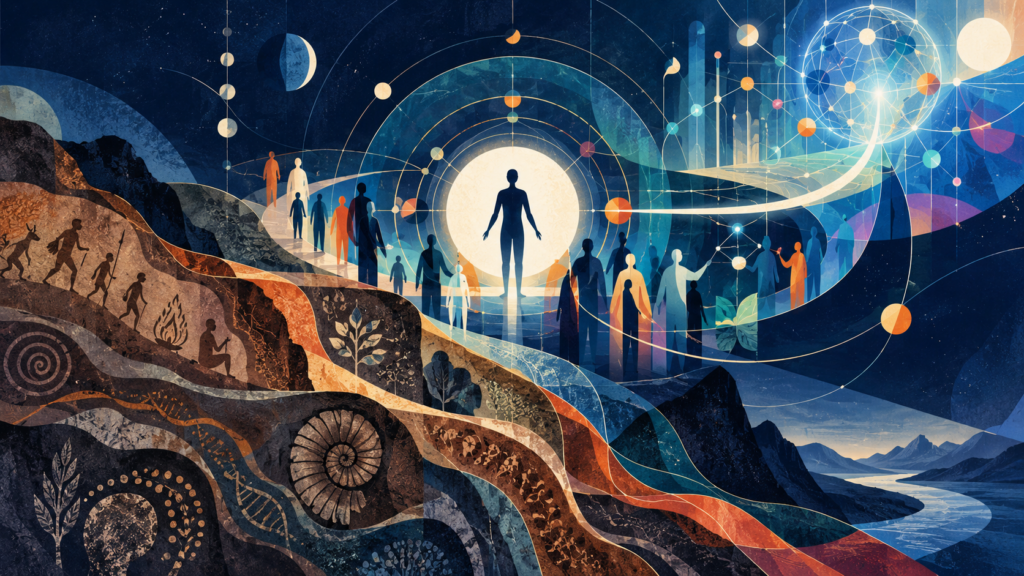
Humanity is an old learning species. Whether we begin with anatomically modern humans or trace the human story through much older hominin lineages, we carry capacities shaped across deep time: pattern recognition, cooperation, caregiving, attachment, threat detection, imitation, storytelling, toolmaking, and social learning.
We do not inherit ready-made answers. We inherit potential ways of knowing.
Modern tools can make those capacities more visible, more connected, and more usable. The opportunity is to shorten the distance between experience, insight, knowledge, coordinated action, and improved conditions.
Inherited sorrow
Inherited harm is sorrow carried across time.
It is the grief of what people endured, what they were denied, what they were taught to fear, and what they unknowingly passed forward through institutions, families, narratives, habits, and systems.
No one chooses the conditions they inherit. But people choose what they learn, what they refuse to repeat, and what they make possible next.
Sorrow can become knowledge. Knowledge can become usable wisdom. Usable wisdom can interrupt a cycle.
The Raffaelle Relational Equation
HE + SHE × FIT = US
The equation is not literal mathematics. It is a teaching and interpretive architecture for understanding how distinct people, perspectives, capabilities, and systems become more capable when brought into functional relationship.
- HE may signify he/him, the individual participant, Human Endeavor, or human empowerment.
- SHE may signify she/her and the relational counterpart, as well as Safety, Health, and Environment.
- FIT is the relational multiplier: Fragmentation → Integration → Translation. Integration connects the parts. Translation makes the connection useful.
- US is the emergent whole: us, many aligned, a functioning relationship, United States, or a sustainably united human community.
The equation can be read as the movement from inherited sorrow toward renewed collective possibility. A person or community does not escape history by denying it. We bring distinct inheritances into relationship, develop the capacity to fit them to the conditions at hand, and create a more coherent “us.”
Its relational logic is:
What we inherit matters.
What we learn changes what we can see.
What we choose together changes what becomes possible.
The equation describes the movement from inheritance to agency. It recognizes that history remains active, but it does not have to remain sovereign. FIT determines whether connection becomes capability.
The equation also has a companion proposition:
Inherited sorrow + conscious relationship + usable knowledge = renewed collective possibility.
This is not a softer or more politically acceptable way of saying the same thing. It names the human reality that the equation must be capable of meeting. People arrive in the present carrying memory, injury, fear, love, skill, adaptation, and unfinished grief. If we refuse to name inherited sorrow, we mistake inherited conditions for personal failure or pretend that equal participation begins from equal circumstances.
The point is not to assign permanent guilt or identity to anyone. The point is to learn what human beings carry, how it shapes present choices, and what becomes possible when that knowledge is brought into a conscious relationship with others.
Diversity as adaptive potential
Genetic variation can increase the range of traits available within a population and may provide resilience in the face of disease or environmental change. Human genetic history also reflects migration, interbreeding, and exchange rather than isolated, pure lineages.
The same principle can be extended carefully into social life. Cultural, linguistic, experiential, technical, and intellectual diversity expand the range of interpretations and responses available to a society.
Diversity alone does not guarantee resilience. It becomes resilience when a society can create relationships, institutions, and feedback systems capable of learning across difference.
The American possibility
The United States has repeatedly brought together people from many ancestral, cultural, linguistic, religious, and intellectual lineages. Its distinctive promise is not purity. It is recombination.
America’s advantage is the ability to bring different inheritances into contact—and, at our best, turn difference into capability.
This claim must include the unfinished record: exclusion, forced assimilation, racial hierarchy, dispossession, and unequal access to participation. These are not exceptions outside the American story. They are part of the inherited material that must be understood and transformed.
The national superpower is therefore not simply diversity. It is the potential to convert difference into shared capacity through learning, contribution, participation, and correction.
Essential needs and the real-world moment
The purpose of learning about ourselves is not endless self-analysis. It is to arrive more capable at the moment that requires a choice.
Human beings still need the essentials: safety, nourishment, shelter, health, belonging, dignity, agency, trustworthy connection, and a meaningful opportunity to contribute. Every large system—family, school, workplace, healthcare network, economy, government, or technology platform—eventually meets a person at the level of these needs.
This is where inherited sorrow becomes relevant. A person may be responding to the present through an old survival pattern. A community may be organized around an old wound. An institution may reproduce an old hierarchy while describing itself as neutral. A tool may make the pattern faster without making it wiser.
People choose. People learn. Time and deployment matter because knowledge that cannot reach the real-world moment remains inert.
Modern tools become valuable when they help people do something concrete:
- recognize what is actually happening now;
- distinguish an immediate need from an inherited reaction;
- bring relevant experience and knowledge into the decision;
- see who is affected and what consequences may follow;
- identify what capacity, care, or coordination is missing;
- choose an action that improves the conditions for people involved;
- observe what happened and correct the next decision.
The same tools can also hide reality, intensify fear, manipulate attention, and carry inherited harm farther and faster. Therefore the question is not whether a tool is modern or powerful. The question is whether it helps human beings perceive the real condition, meet essential needs, relate responsibly, and act with enough feedback to learn.
That is the practical meaning of making knowledge usable: bringing the right insight, to the right people, at the right moment, in a form they can understand and act upon.
The power we have together
This is not only a warning about what modern tools might do to us. It is an invitation to become more capable with what we already are.
Humanity does not need to erase its past in order to have a future. We cannot erase what we stand upon—as individuals, as families, as cultures, as nations, or as a species. The inherited material includes sorrow, but it also includes courage, memory, invention, devotion, humor, adaptation, care, and the long practice of surviving conditions we did not choose.
When we face that reality without running from it, romanticizing it, or distorting it, it becomes available for learning. When we bring that learning into relationship with other people, with the living world, and with AI, it becomes a source of capability.
AI does not have to replace the human inheritance. It can help us examine it, connect it, translate it, test it, and make it usable at a scale and speed no individual could achieve alone. Human beings contribute lived experience, moral consequence, embodied perception, purpose, and responsibility. AI contributes pattern recognition, memory, synthesis, simulation, and reach.
Together, these capabilities can become abundant fuel for the soul of humanity—provided we do not surrender judgment, relationship, or responsibility to the tool.
Our human and AI power is found in combination: what humanity has become, what AI can help us see, and what we choose to make possible together.
The task is not to flee our history or pretend that evolution has finished. We are a species with at least three hundred thousand years of accumulated adaptation—and a far older lineage of learning, cooperation, and change. It would be wise to use what we have learned.
The future does not ask us to become less human. It asks us to become more conscious of what being human already contains.
Closing insight
We are ancient beings with inherited capacities, living inside unprecedented systems.
The task is to recover and recombine what humanity already carries—embodied wisdom, ecological belonging, intergenerational memory, cooperative problem-solving, curiosity, and creative invention—and make those capacities conscious and usable now.
We inherit sorrow. We learn from one another. We choose what it becomes.
That is the human promise within the Raffaelle Relational Equation:
HE + SHE × FIT = US.
And that is the opportunity of human–AI collaboration: not escape from humanity, but a more capable encounter with it.