What can we know, build, measure, model, and make possible?
The challenges shaping modern life do not arrive one domain at a time. Technology changes work. Economics shapes health. Institutions affect belonging. Culture influences what we recognize, reward, tolerate, and imagine possible.
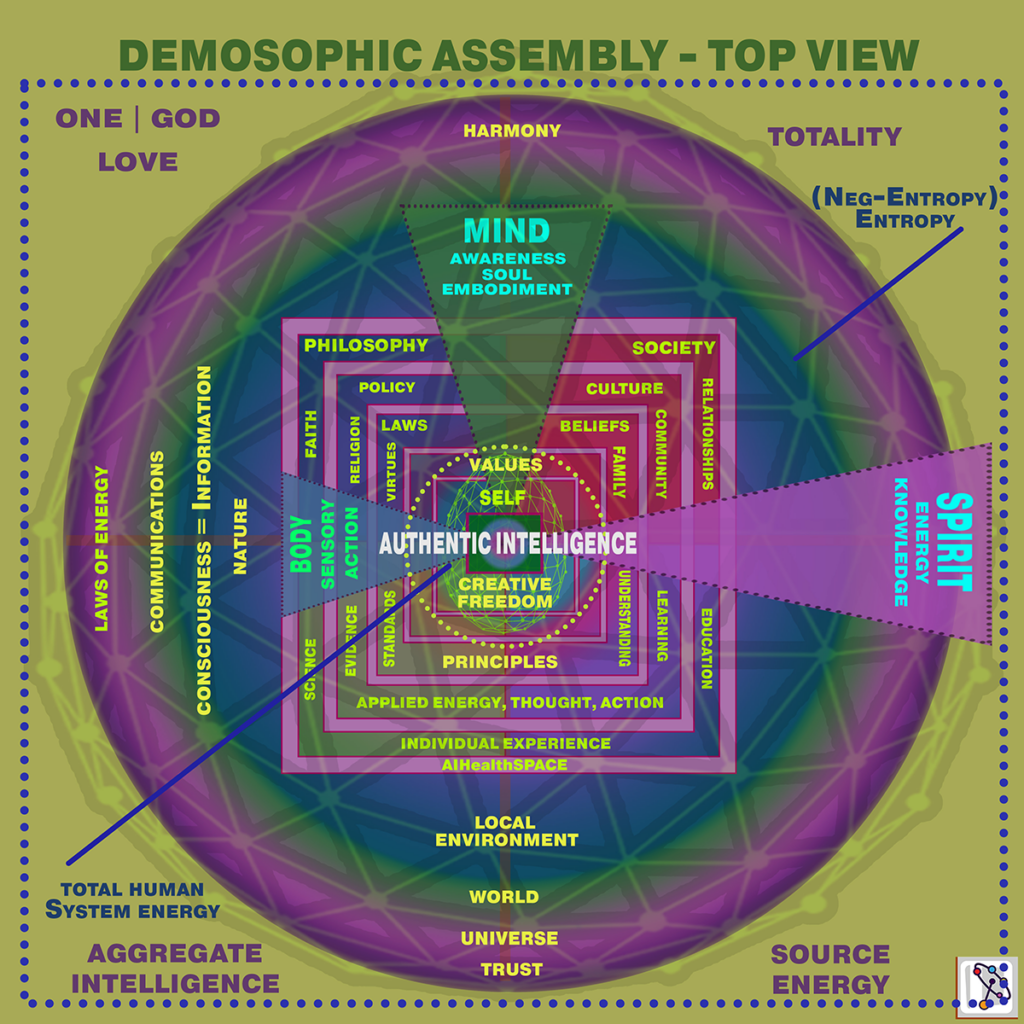
The Demosophic Framework helps us see these relationships more fully—connecting human needs, lived experience, knowledge, infrastructure, power, and responsibility so that people and systems can make wiser decisions in the moments that matter.
We inherit institutions, disciplines, technologies, economies, beliefs, and social arrangements that divide human reality into manageable parts. Those divisions can be useful. But the life moving through them remains whole.
A healthcare decision can also be an economic decision, a technological decision, an ethical decision, a family decision, and a question of public trust. The same is true of decisions about artificial intelligence, education, work, infrastructure, democracy, and community life.
When we see only one part, we may solve for one outcome while transferring cost, risk, fear, or suffering somewhere else. When knowledge remains separated from lived consequence, even extraordinary capability can produce fragmented results.
The Demosophic Framework was developed to help us encounter more of the whole.
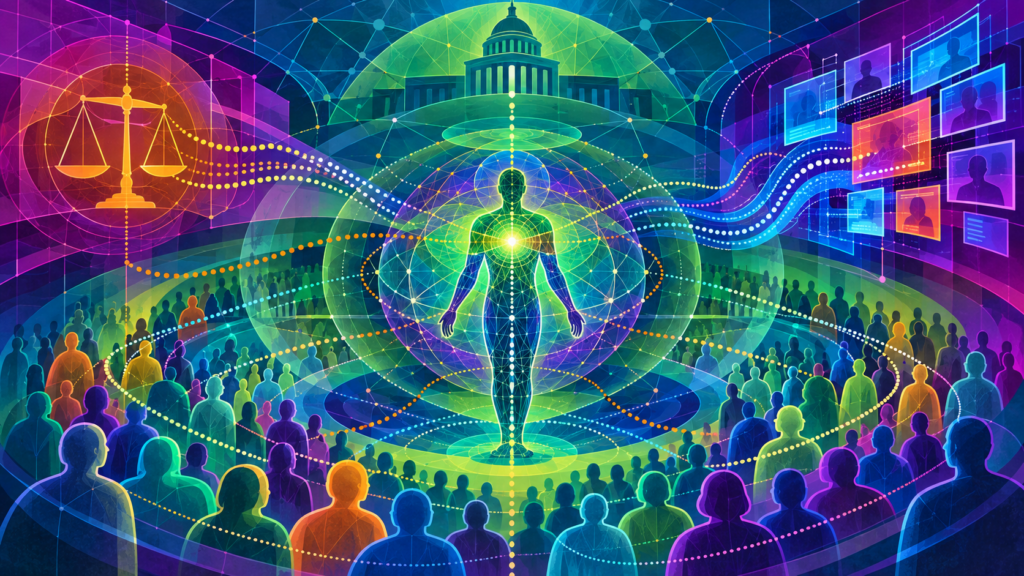
The person is not separate from the system, and the system derives its human purpose and value from the lives moving through it."
The purpose of the Demosophic Framework is not to prescribe a single ideology, answer, or future. It is to improve the conditions under which understanding, judgment, participation, and responsible action become possible.
It asks us to widen the field:
The Framework creates room for information to become context, context to become recognition, recognition to become understanding, and understanding to become more capable human agency.
Its North Star is neither control nor perfection. It is the continual development of conditions in which people, communities, organizations, and institutions can reduce unnecessary harm, strengthen contribution, learn from consequence, and support human flourishing.
The work is not to collapse difference, but to place distinct fields in a relationship capable of generating greater context and wiser action.
What can we know, build, measure, model, and make possible?
How is value created, exchanged, distributed, and sustained?
What gives life meaning, dignity, moral orientation, and coherence?
How is life actually experienced—and where do consequences become real?
Each way of knowing contributes something necessary. None should be permitted to erase the others.
People are not only users, patients, employees, consumers, constituents, data sources, or recipients of decisions made elsewhere. Their experience, needs, aspirations, and capacity to contribute become part of the intelligence of the system.
By connecting human needs, lived experience, knowledge, infrastructure, and responsibility, the Framework helps people see more of the whole and identify more responsible next actions.
Widen the decision field and identify transferred consequences.
Connect purpose, operations, technology, culture, and public consequence.
Bring distinct experiences and capacities into shared learning.
Recognize systems while strengthening agency and contribution.
Design environments that account for the whole person.
Align accelerating intelligence with human context, maturity, and consequence.
Connect knowledge, lived experience, technology, economics, relationships, and trust.
Recognize human capability, participation, development, and value.
See beyond the immediate decision to the conditions choices create.
A living laboratory for capacity, identity, health, leadership, and belonging.
Strengthen communication, deliberation, learning, and shared participation.
A living stream of questions, insights, and perspectives to contemplate with the goal of seeing more clearly.


Reimagining work and commerce around human capacity, essential needs, and the infrastructures that sustain modern civilization.
Developing human capacity in ways that support performance, wellbeing, identity, and a life well-lived.
Studying humanity by studying ourselves, our relationships, and the systems shaping modern life.
Exploring human-centered communication ecosystems that use longitudinal context to strengthen wellbeing, agency, and societal cohesion.
When trusted longitudinal understanding makes health, capacity, contribution, and consequence more visible, how should value flow differently?
The Framework asks us to move beyond passive recipients, isolated experts, or competing interests and become more capable co-architects of the conditions we share.
This is the readiness framework that enables super-intelligence to do good—and this is your invitation to participate.
Demosophy uses essential cookies to operate this website and optional cookies to understand site use, support embedded media, and improve your experience. You may accept optional cookies, decline them, or choose your preferences. You can change your choice at any time.
Our site uses cookies. We use them to improve your user experience. By entering our site you consent to the policies shown <here>
Notifications