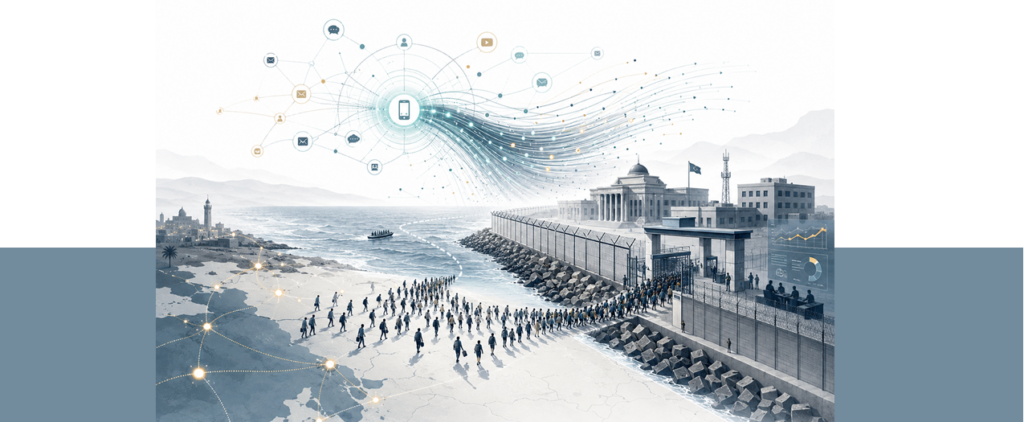
THE MODERN VULNERABILITYA physical barrier designed to manage gradual movement can be overwhelmed by a communication network capable of coordinating tens of thousands of people almost instantaneously. |
When communication velocity exceeds institutional comprehension, human movement can become a destabilizing force before democratic institutions have established a shared understanding of what is happening.
Ceuta should not be viewed as a distant European anomaly. Legal rulings, administrative signals, political statements, news reports, and visible examples of entry can be simplified, distorted, algorithmically amplified, and converted into coordinated physical behavior before institutions understand the event. The United States has experienced a related vulnerability at its southern border, where smugglers and other actors have used social media, policy ambiguity, and perceived windows of opportunity to shape movement and strain receiving systems.
1 Information becomes operational Under high-pressure conditions, information does not merely describe reality; it changes expectations, timing, routes, and behavior. | 2 The border begins before geography The operational border extends through phones, platforms, courtrooms, newsrooms, diaspora networks, and human expectations. |
3 People are not the weapon Human vulnerability, hope, fear, and movement can be weaponized by actors who remain distant from the physical risk. | 4 Siloed competence can still fail Law, media, technology, security, and humanitarian systems may each fulfill narrow mandates while the whole system destabilizes. |
The answer is not to communicate less, suppress lawful movement, or weaken democratic protections. It is to govern the full chain from institutional signal to digital amplification, human expectation, physical movement, and public consequence.
Leadership domain | Immediate responsibility |
Policy and law | Model how consequential laws, rulings, and administrative changes may be simplified, misinterpreted, marketed, or weaponized before they take effect. |
Government communications | Reach vulnerable populations through the same languages, devices, platforms, communities, and trusted intermediaries used by smugglers and influence actors. |
Media and journalism | Recognize that framing, repetition, urgency, and visible examples can alter not only public opinion but real-world movement. |
Technology platforms | Evaluate when recommendation systems, virality mechanisms, paid promotion, and private forwarding foreseeably contribute to dangerous physical mobilization. |
Security and intelligence | Develop real-time narrative intelligence focused on velocity, coordination, incentives, and physical consequences, not only technical truth or falsity. |
Humanitarian and local leaders | Protect life and dignity while helping design systems that do not convert dangerous crossings or organized surges into perceived advantages. |
Institutional signal → interpretation → simplification or distortion → algorithmic amplification → perceived urgency → human assembly → physical movement → infrastructure strain → political reaction → loss of trust
WHO IS RESPONSIBLE FOR THE INTEGRITY OF THE FULL CHAIN? The answer cannot belong to one institution. But responsibility cannot remain nowhere. |


Our site uses cookies. We use them to improve your user experience. By entering our site you consent to the policies shown <here>